

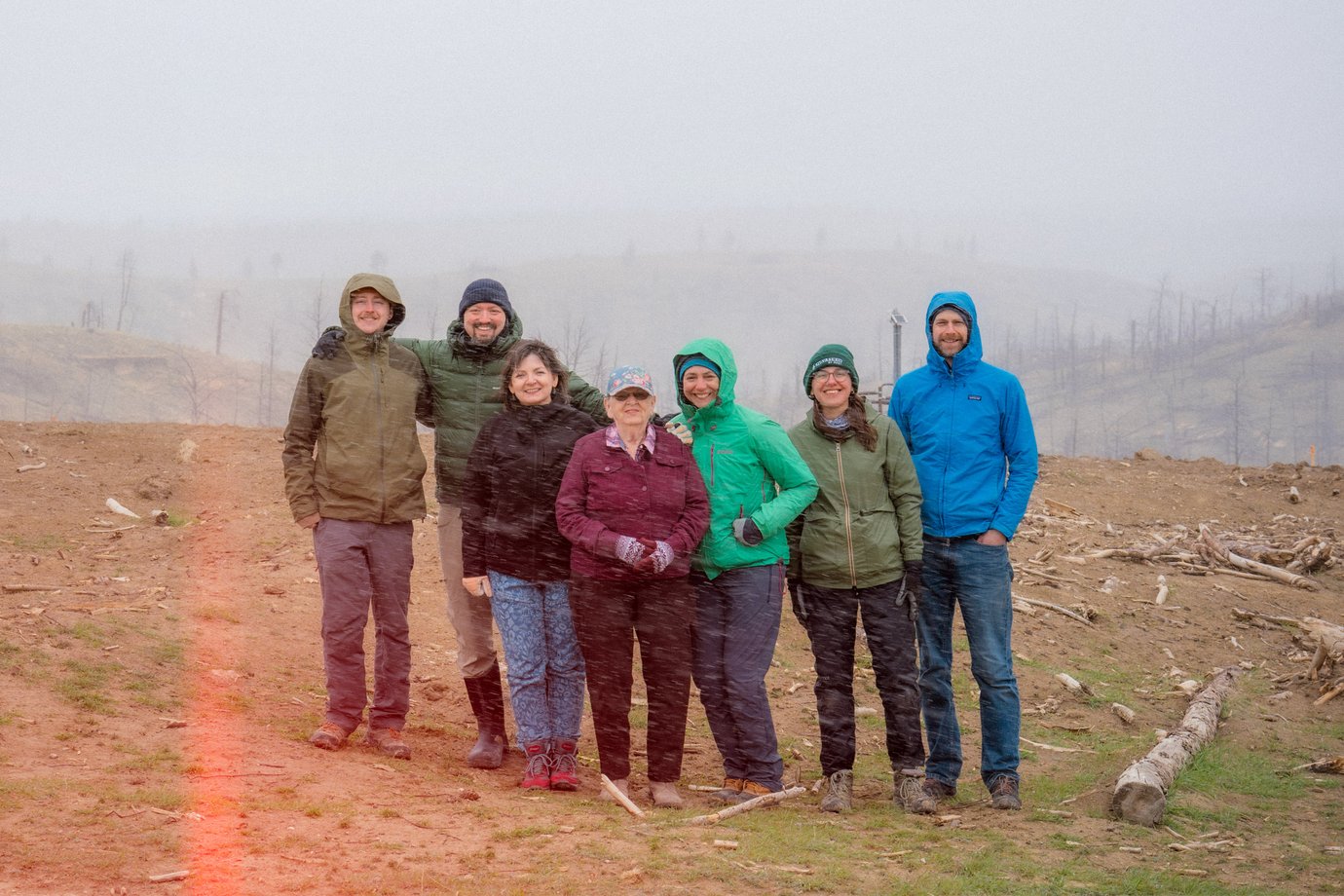
The wind gently ruffled the ponderosa pines that cocooned us from the full chill of the breeze. That same breeze faced no other barrier across the eastern Montana hilltops, and the snow-capped Wyoming Tetons beyond.
We were tucked in a nook of a valley, the only section of the property spared by the 2021 Poverty Flats Fire. We were celebrating over “Grandma’s Famous Pickles” and chili prepared by the Gentrys, surrounded by the potluck contributions of their friends and family.
The pickles were hard earned. 3,500 seedlings had been planted that day, with 3,000 more planned for the next. 30 samples taken from the log chamber. Three reporters who interviewed just about everyone involved, and 9 hours of footage of it all.
As we reflected on not just the day, but the last year, the majestic trees that surrounded us were an emblematic backdrop of what once covered the coulees before the fire’s devastation left nothing but blackened, branchless and broken tree stands across the landscape.
“We couldn’t even see these rocky ledges before. It was nothing but pine trees. Our beautiful, ponderosa pine trees. The air smelled so good out here.”
— Velma Gentry
Velma Gentry has lived on this land, and cared for it, for the last 60 years. Her daughter, Rebecca, shares the responsibility for the decades ahead. Last October, they traveled to see their seedlings at our nursery in Roy, Washington, as they grew big enough to plant.
On April 15th, they welcomed them home. It was a deeply moving moment full of hope. Walking around, taking in the landscape myself for the first time, it was heartbreaking to see the remnants of what had been before.
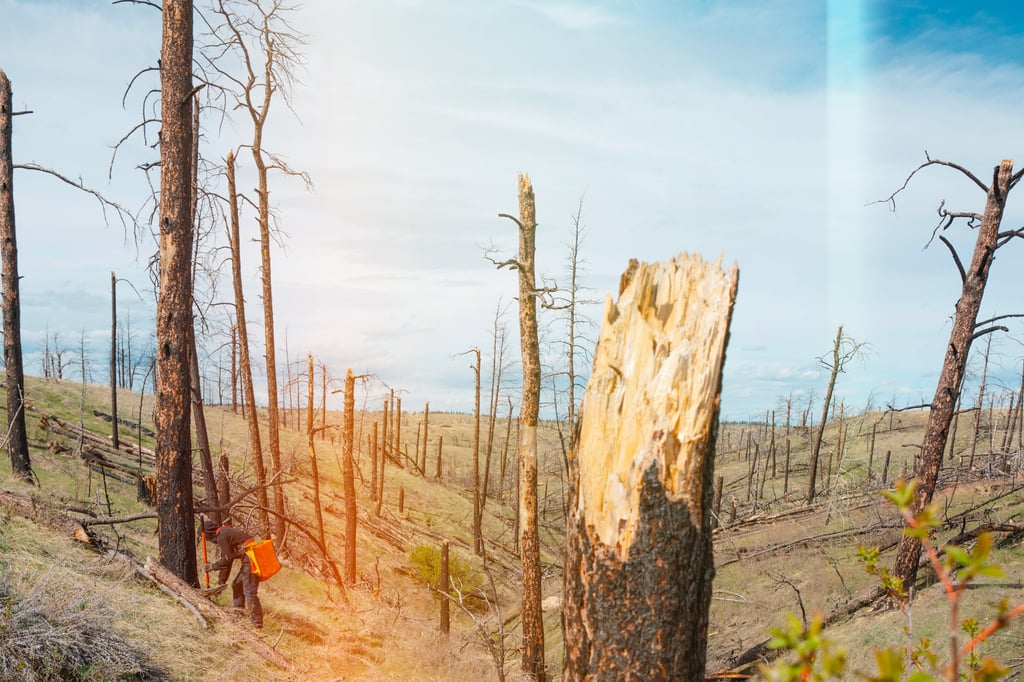
A tree planter digging a place for a ponderosa pine seedling on the Gentrys property
I asked Julian, our forester who was leading the reforestation, how old some of the trees had been, “Many 70 years and older. Those out there on their own on the hilltops, even older, more than 100 years, easily.”
What did these trees witness over the last century, and what challenges will the new seedlings face in the next? Back in October, when MT1 landowner Rebecca Gentry had the opportunity to see her seedlings for the first time at our Silvaseed nursery, she remarked, "these seedlings have big roots to fill.”
We’ve certainly given them their best chance.
Each seedling was planted by hand, cultivated from seed that had been hand-selected, x-rayed for quality, and gathered from cones collected in an equivalent eco-region. “Locally adapted seed” is a term you’ll see and hear us say. It means we collect cones from areas with climate, elevation, and soil conditions that closely match where the seedlings will be planted.
Mast has been on a mission to make post-wildfire reforestation scalable. Over the last decade, U.S. wildfires have burned an average of about 7 million acres a year, roughly the size of Massachusetts. Many burned forests can recover naturally, but high-severity fires can erase seed sources and leave landscapes unable to regenerate without help. That’s the race Mast is working against: getting forests growing again before more burned landscapes are left behind.
After a year of cultivation, when seedlings are gradually prepared for life outside the nursery, each one was planted by hand with a shovel in less than 10 seconds. That’s enough time for the planters to hack away the grass to lessen competition, create the hole, place the seedling in straight, and firmly press the soil in front of the seedling. Each seedling was also placed where it would have the best chance for moisture and water retention, shade, and protection from predation by hungry herbivores.
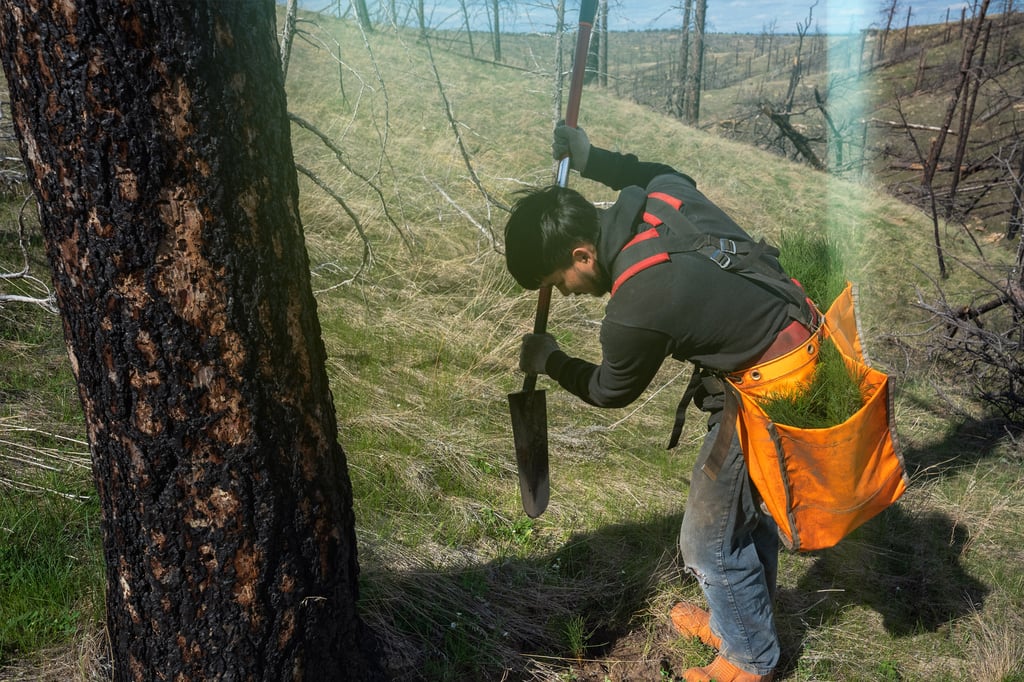
A tree planter planting a ponderosa pine in the shade of a standing dead ponderosa pine
The crew of four planted 6,500 seedlings within two days. It was a feat of astonishing endurance, uphill all ways. When they joined the picnic, some thought they were just being shy by not wolfing down the rest, but in reality their stomachs were in knots of exertion. In terrain like this, which they stated was “easy compared to some projects” they burned the caloric equivalent of running two marathons in one day. Every seedling was carried, placed, and planted by hand.
Over those two days we faced what the area’s wildlife faces every day: the loss of wind cover, protection, and shade. It was in the 70s, then the 40s and then we were pelted with sleet. Trees do so much more than they are economically valued for.
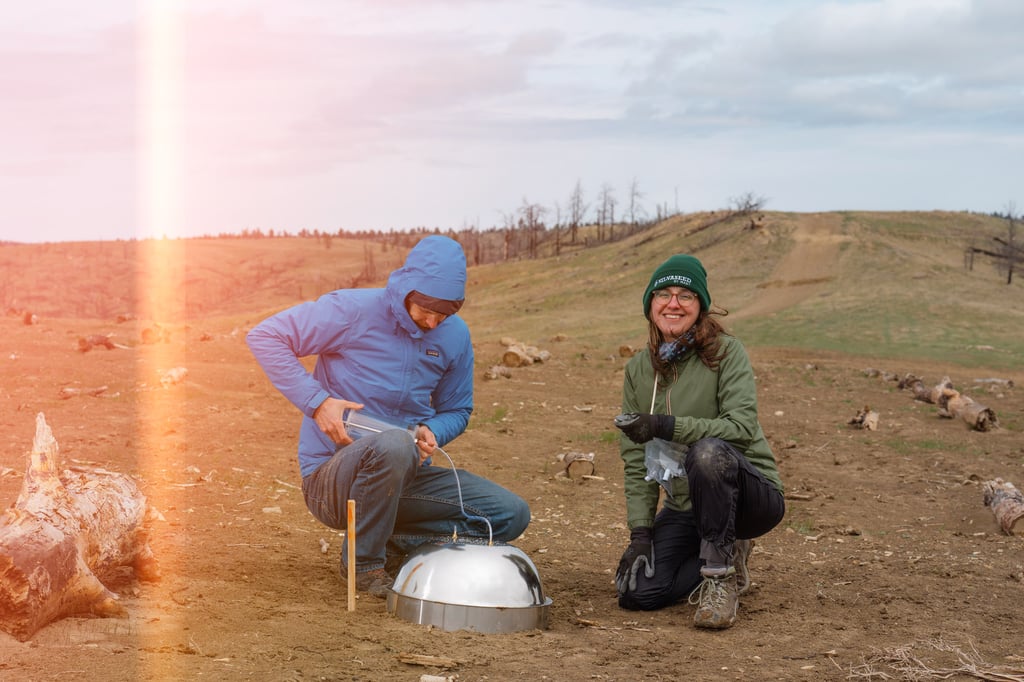
Geoff (left) and Tiffani (right) pull gas samples from the top of the burial chamber to send to a lab for testing
While the seedlings took their rightful places on the land, our Product Team was taking samples across the biomass chamber. The samples are additional quality assurance checks on whether or not any methane is being generated or released from the site. This is unanticipated based on the project's design and execution, but because we’re advancing the science for this carbon removal pathway, the more data the better. Early results are consistent with the project’s design expectations. The condition of the roughly 5,000 tons of logs beneath the cap remain stable.
That same day, we announced the sellout of MT1’s carbon removal credits. In a full circle moment, the burial of the fire-killed trees from across the Gentry’s property provided the necessary funds to grow and plant these resilient seedlings. After feeling like they lost nearly everything, the Gentry's forest is now growing back.
Over cups of lemonade, we toasted to the days ahead.